New vehicles are just the start...
What far-fetched transport tech will lure commentators to declare ‘peak mobility innovation’ this year? Perhaps it’ll be something like exercise bike company Peloton’s CommuCycle concept - an exercise bike in a car so you can cycle while you drive. It’s an extreme example of the proliferation of (generally more sensible) new vehicles, small and electric, currently finding their niches. E-scooters, e-bikes, and those one-wheel hoverboard things are all providing fun and hopefully sustainable ways to move around. But personal vehicles aren’t all that come to mind when I think of mobility innovation.
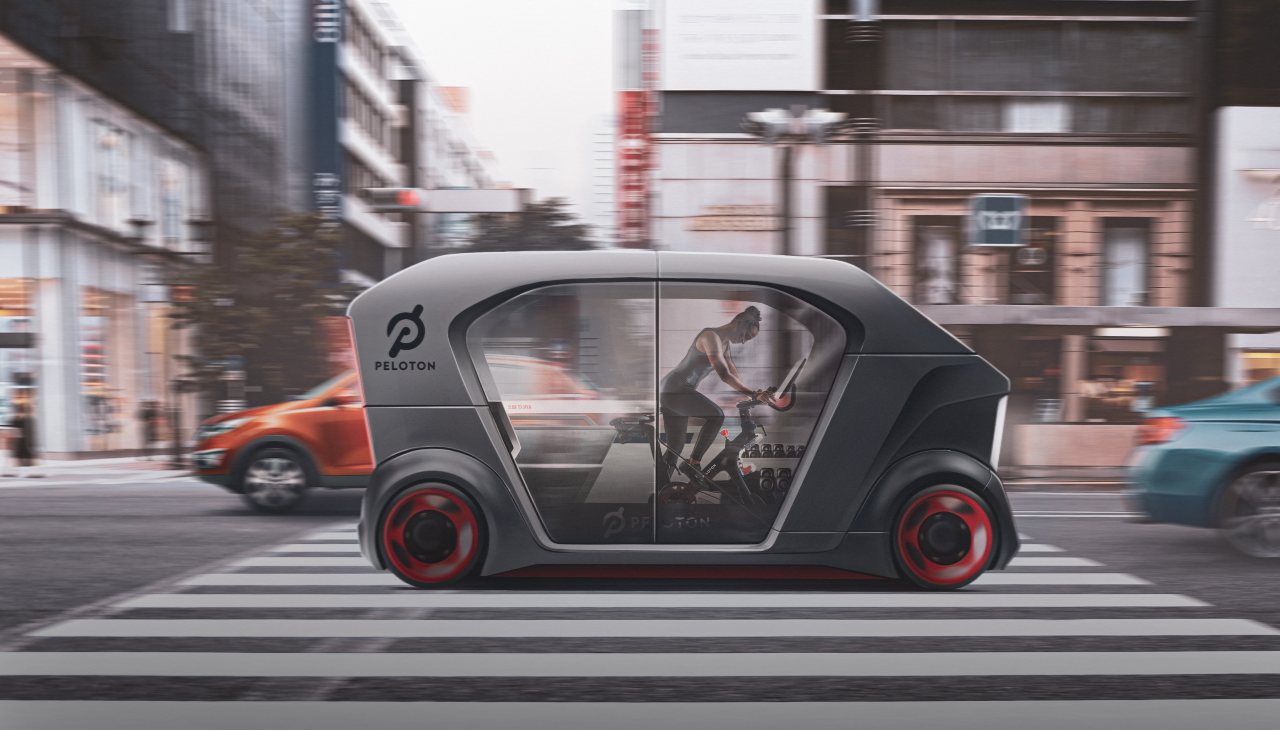
Peloton's CommuCyle concept © autoevolution
Innovations in the way travel behaviour is influenced, often through explicitly political action, are occurring alongside the introduction of new technologies. Barriers, bus gates and filters have been erected, the highway code has been updated, streets have been redesigned, and volunteers and geographers have worked to disrupt the dominant navigation platforms, all with the shared goal of making travel more sustainable and cities healthier places to live.
The theories underpinning these changes are not new. In the seventies, Jan Gehl pioneered the application of architectural design principles to ‘life between buildings’ to make them more inviting to people. Donald Appleyard’s ‘Liveable Streets’ manifesto similarly emphasised the role of streets as places to socialise. Many streets and neighbourhoods have since been built according to these principles, most notably in the Netherlands.
So what’s been innovative about the recent changes to streets in the UK? New low traffic neighbourhoods (LTNs) and temporary bike lanes have been cropping up in cities across England (although predominantly in London). A major innovation here has been the reversal of the usual consult-then-implement process for making neighbourhood changes. Instead, by installing barriers and bus gates then consulting on whether to remove the interventions local authorities have cleverly found a way to overcome the inertia that prevents action on reducing vehicle emissions (this is something Janett Sadik-Khan talks about in Ed Miliband’s podcast). These experimental interventions are providing an opportunity to find out more about how our travel behaviour is shaped by the built environment. There is a lot we don’t know about the impacts of low traffic neighbourhoods and only one way to find out: implement and monitor. Thankfully, researchers like Rachael Aldred are keeping a close eye on changes to people’s travel patterns using travel surveys.
A second quietly radical transport innovation is the introduction of an explicit ‘hierarchy of road users’ in the highway code. The illustration produced by the Department for Transport (DfT) nicely summarised the main changes which give greater priority to pedestrians and cyclists in order to “ensure a more…considerate culture of safe and effective road use that benefits all users”. Related to this is the campaign to allow people to more easily paint zebra crossings. These interventions are at once both mundane and ambitious. They target very small-scale human behaviours concerning differences of seconds at an individual crossing. But the theory is these small-scale interactions will make walking and cycling feel safer and more enjoyable and therefore encourage more ‘active travel’. This approach to transport regulation acknowledges that, all else being equal, motorised transport dominates other road users and claims that this dominance matters to vulnerable road users. It’s innovative because it takes a proactive approach to safety that acknowledges the subtle ways that road users affect one another. As we are able to record people’s movements and physiology more easily, our understanding of the importance of these small-scale interactions could improve: for example, by measuring biometric data from cyclists as they travel through cities to identify stressful locations (https://issues.org/pedestrian-bicycle-urban-streets-deaths-biometric/).

Illustration showing one of the changes to the Highway Code related to the road user hierarchy (Department for Transport, 2022)
In July, the Slow Ways project launched its beta site, a routing service for walking between towns across Great Britain. Volunteers have crowd-sourced the routes by scouring Ordnance Survey maps to join up disparate footpaths into something more coherent and useful. Routing services are increasingly informing and mediating our use of public space and tend to treat such spaces in purely geometrical terms as distances to be traversed at a particular speed. But the spaces we move through are places with enjoyable characteristics that can affect and be affected by our presence. The Slow Ways project, along with other walking focussed routing services such as GoJauntly, makes a concerted effort to account for these experiential considerations when recommending routes. For a start, they explicitly prioritise walking, which generally has positive impacts on the (urban) environment. They also pay attention to granular and aesthetic details of the route, qualities that matter more to vulnerable road users given their slower speeds of travel and exposure to the immediate environment. Incorporating them into routing services helps resist the tendency towards always adopting a simplified view of routes disconnected from the places they move through.
These innovations take a different approach to mobility. They attempt to account for the ways that our movements through public spaces affect one another and to build this into the design of transport systems in increasingly granular ways. As our movements are recorded and analysed in increasing detail, we should use this information to develop our understanding of these experiential aspects of travel rather than doubling down on quantifying a narrow set of metrics in painstaking detail. In addition to creating fantastically efficient new vehicles, we can also innovate in terms of how we create and monitor environments that encourage more sustainable travel behaviour.